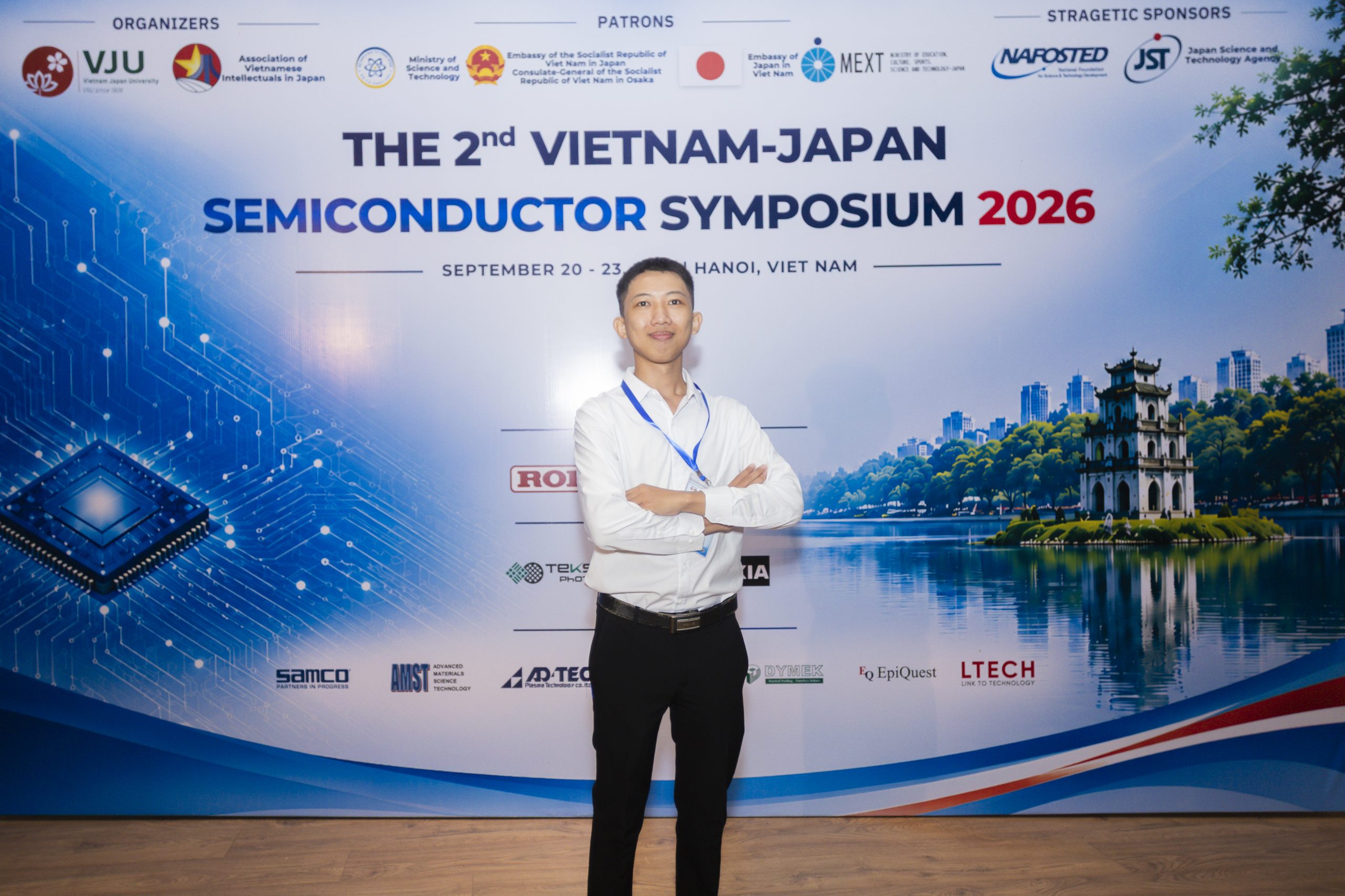
Phan Quốc Minh did not expect his research to attract so much attention from researchers and experts at VJSS-2026, where he took part for the first time as a poster presenter at an international conference. From questions and discussions around his poster to the moment his work caught the attention of Prof. Tsuyoshi Usagawa, the experience gave the outstanding graduate of the Master’s in Nano Technology (MNT) at VNU Vietnam Japan University (VJU) valuable new insights for his research journey.
1. First, could you tell us a little about yourself?
My name is Phan Quốc Minh, and I am from Nha Trang, Khanh Hoa Province. After earning my Bachelor’s degree in Physics, I was encouraged by my academic supervisor, Assoc. Prof. Dr. Bùi Nguyên Quốc Trình, to continue my studies at VNU Vietnam Japan University. This opportunity brought me to Ha Noi, where I could continue my education and develop myself. A few months ago, I graduated with distinction from VJU’s Master’s program in Nano Technology.
2. Could you briefly introduce your poster at VJSS-2026?
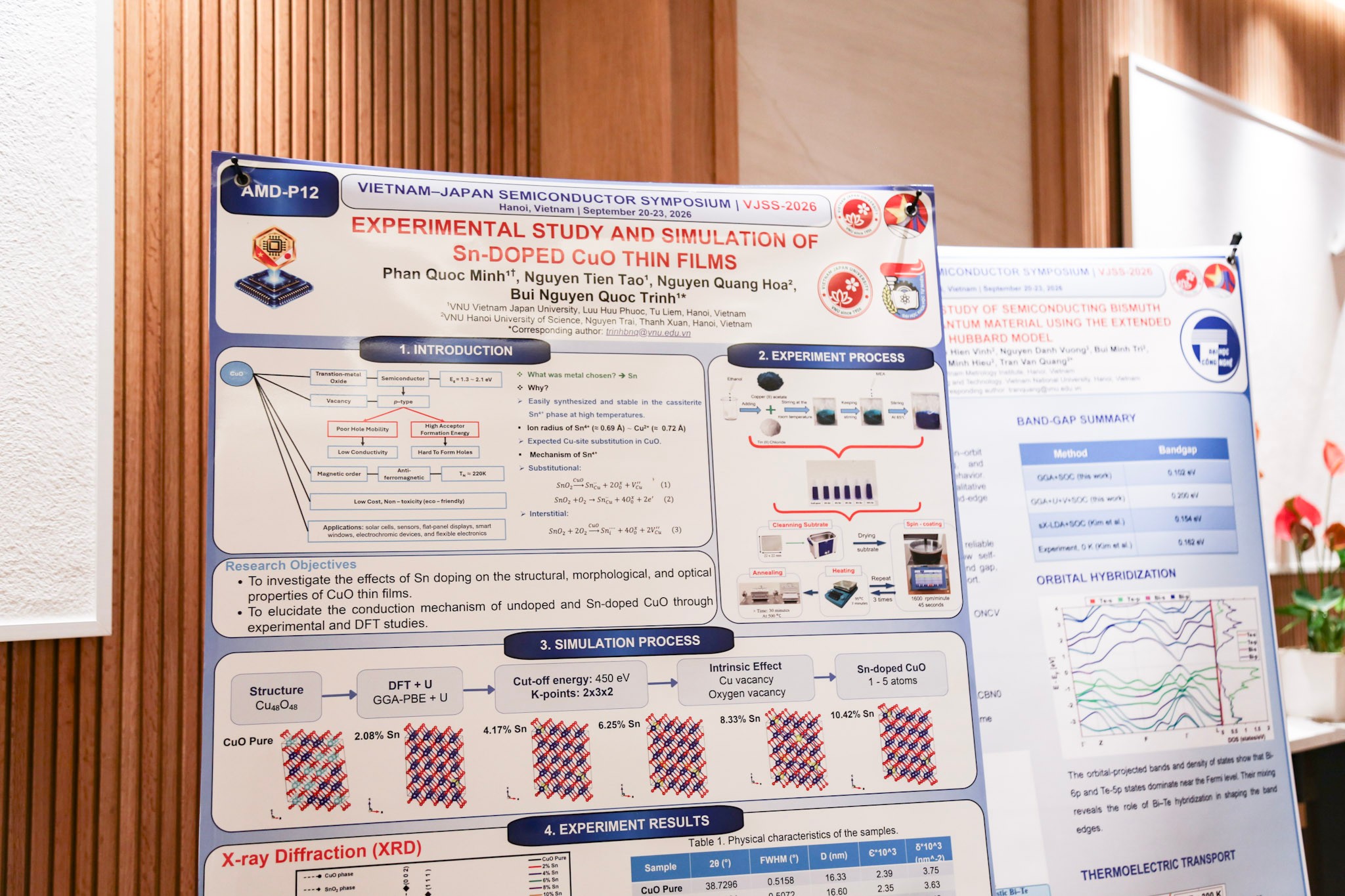
Our poster explores the correlation between experimental results and simulations when doping another metal into a host material, specifically Sn-doped CuO. The study combines experimental characterization with basic Density Functional Theory simulations incorporating the Hubbard correction (DFT+U) to clarify changes in the structure, properties, and defect mechanisms at the atomic level, and to relate them to the changes observed at the nanoscale.
Rather than focusing on whether a particular property of the material is good or bad, our research focuses on the relationship between the experimental and simulation results, using that relationship to identify the mechanisms and phenomena occurring deep within the material structure.
3. How did you carry out this research?
Under the guidance and direction of Assoc. Prof. Dr. Bùi Nguyên Quốc Trình, I was encouraged to shift my approach from being purely experimental to combining experiments with simulations based on fundamental principles of materials physics. To pursue this approach, I began learning the fundamentals of simulation under the guidance of Prof. Koun Shirai and Mr. Nguyễn Tiến Tạo.
At first, learning simulation from the very beginning was a major challenge. However, through the MNT internship program, I had the opportunity to study directly with Prof. Shirai and members of the simulation research group at the laboratory of Prof. Morikawa Yoshitada. This experience helped me gradually build a foundation in simulation and integrate it with my experimental research.
4. Your poster attracted considerable attention at VJSS-2026. How did you feel about that?
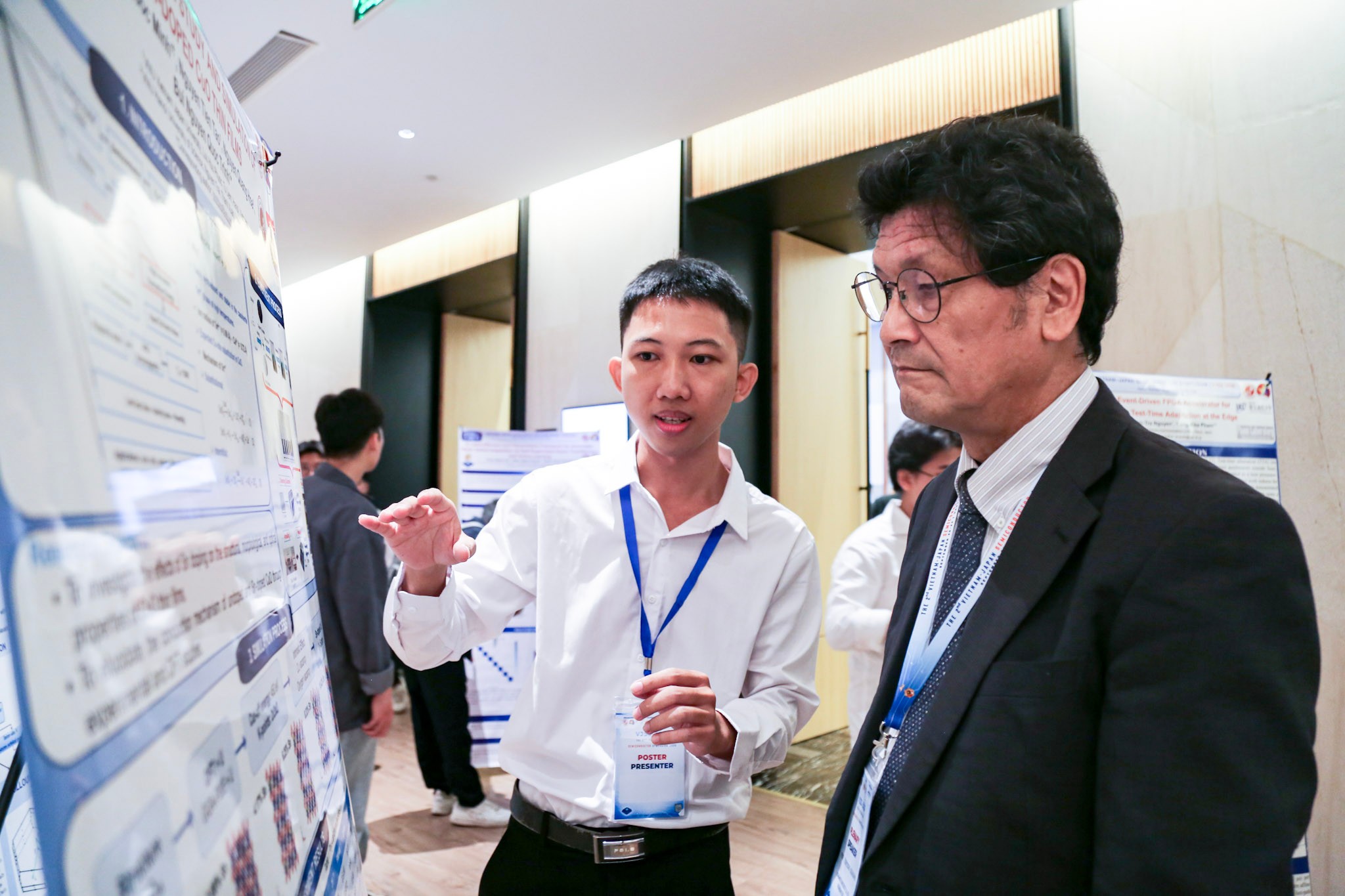
I was surprised by how much interest and discussion the poster and the research questions we raised and addressed received. I was even more delighted when my poster caught the attention of Prof. Tsuyoshi Usagawa. He asked questions such as, “Could you summarize the research problem your group addressed? Did your group conduct only experiments or simulations, or did you carry out both yourselves? Has the correlation between the two approaches been clearly demonstrated in the report?”…
5. How do you plan to develop the research further?
At present, the correlation between the two approaches still lacks some measurements that could provide clearer evidence of the relationship between the experimental and simulation results. This will provide a basis for building a systematic dataset aimed at predicting the properties needed for the future development of thin-film transistors (TFTs). Looking further ahead, this dataset could serve as an input for artificial intelligence (AI) systems, helping to build models that learn from experimental and simulation data and, in turn, support the identification of directions for future materials research.
6. What were your impressions of the other poster presentations?
I went around and looked at the posters presented by other participants, and I was impressed by the diversity of research topics. The datasets, potential applications, connections among different sets of data, and approaches to problem-solving were all very impressive. Some of the studies had also been published in prestigious international journals.
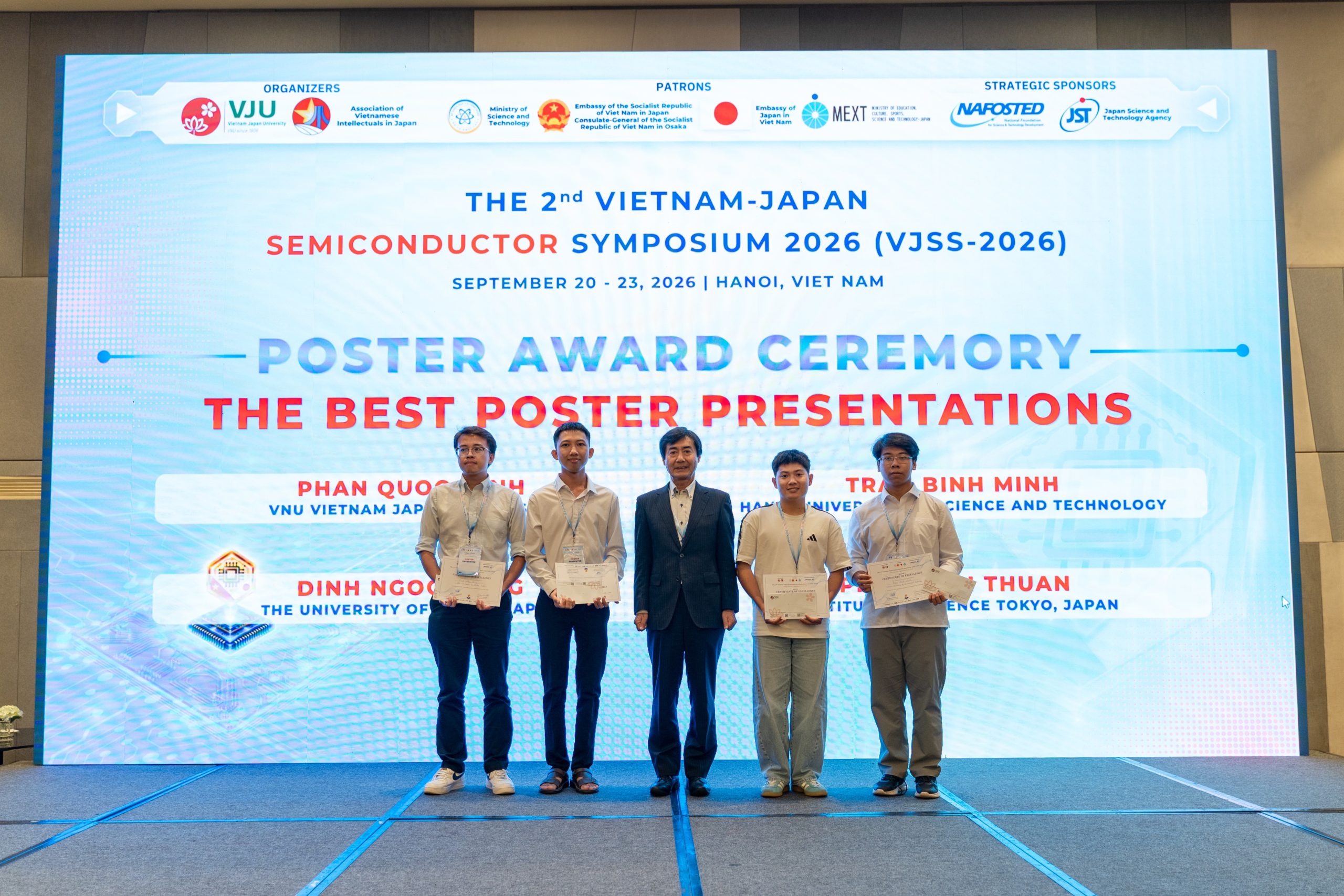
7. What are your thoughts on VJSS-2026?
VJSS-2026 was truly a remarkable event, both in terms of the number of participants and the strong interest in the semiconductor field. In particular, the Lecture Session was almost fully packed, even after the organizers added more seats. As both a participant and a poster presenter, I had the opportunity to learn a great deal of new knowledge while meeting and exchanging ideas with experts and researchers from leading institutions in the semiconductor field in Vietnam, Japan, and several other countries. I was also impressed by the organizers’ thorough preparation, from support for participants to the attention to detail throughout the program.
Finally, I would like to sincerely thank the VJSS-2026 Organizing Committee for giving me the opportunity to take part in such a meaningful scientific conference as a poster presenter for the first time. It was not only an opportunity to share my research findings, but also a valuable experience that gave me many lessons and insights for my future research direction.